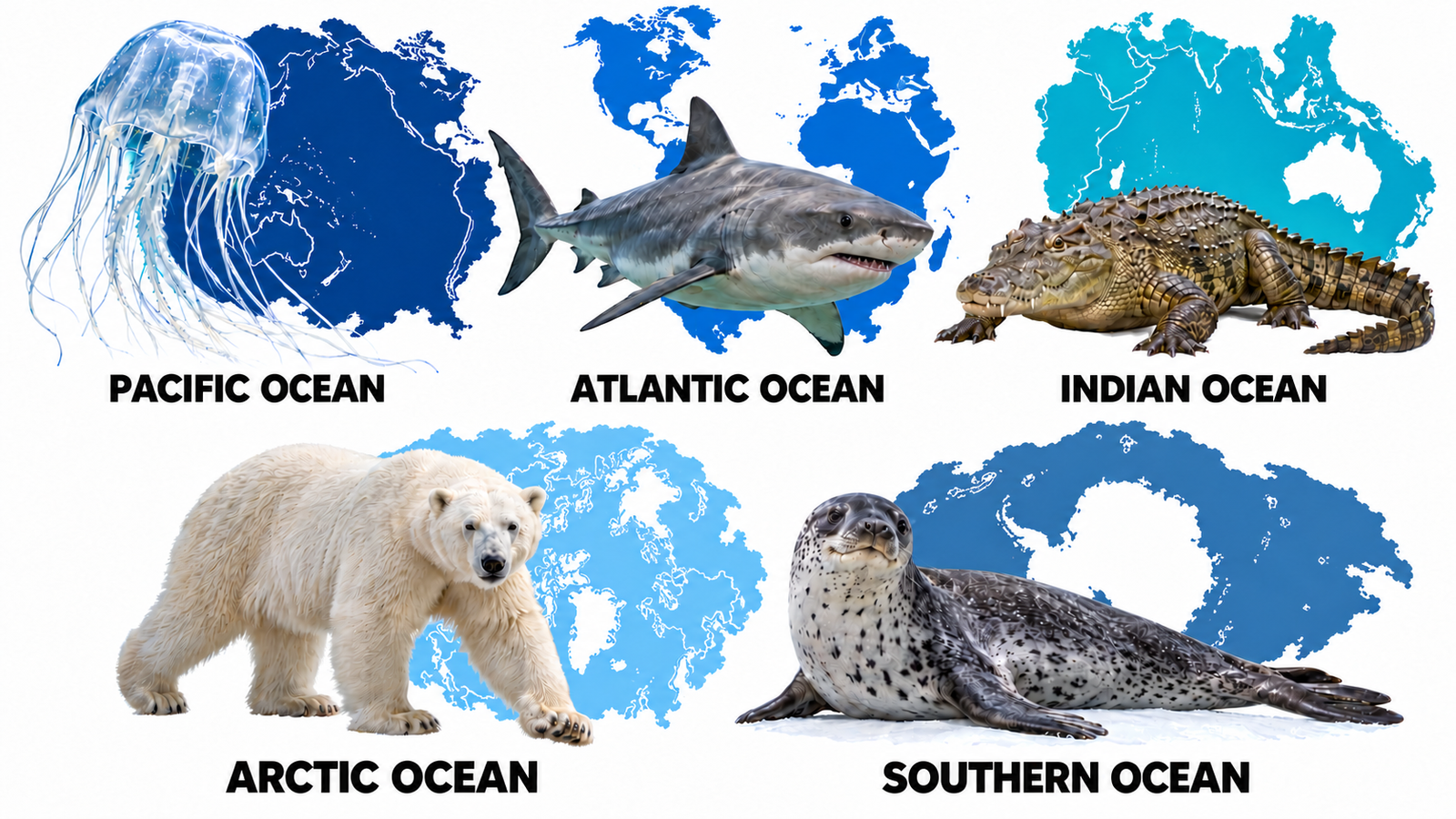
Every ocean on Earth has an animal you really don’t want to meet. Some kill dozens of people a year. Others have killed only once, but they proved they can treat a human as prey.
To pick a winner for each ocean, we weighed documented deaths and attacks, how often the animal crosses paths with people, how fast a single encounter can kill, and whether its record actually belongs to that ocean. In the warm, crowded Pacific, Atlantic, and Indian Oceans, the body count decides. In the icy Arctic and Southern Oceans, where deaths are rare, the title goes to the animal with proof of hunting humans.
Below, you’ll find all five champions in order, with their size, weapons, attack records, and the safety rules that keep people alive. The last one might surprise you.
Pacific Ocean: Why the box jellyfish is the deadliest animal
The deadliest animal in the Pacific has no teeth, no claws, and no brain. The box jellyfish drifts through warm, shallow water from northern Australia to Southeast Asia, right where people swim. Its body is almost transparent, and its bell is only about six inches across. But 15 tentacles hang from each of its four corners, and they stretch about 10 feet when it hunts.
Those tentacles carry thousands of nematocysts, tiny stinging capsules that fire into the skin like harpoons. The venom contains proteins that punch holes in cells, and it attacks the heart. The pain is instant, often compared to a red-hot iron. When stings cover more than half an arm or leg, victims can lose consciousness, stop breathing, and go into cardiac arrest, and severe untreated cases can kill in two to five minutes.
Australia has recorded at least 64 confirmed deaths between 1884 and 2021. In the Philippines, a rough estimate puts box jellyfish deaths at 20 to 40 a year. Great white sharks kill fewer people a year in the Pacific, and the blue-ringed octopus and cone snail, despite powerful venom, rarely cause deaths.
In Queensland, stinger season runs roughly November to May, and swimmers stay inside stinger nets and wear full-body Lycra suits. After a sting, call for help, pour vinegar on it to disable stingers that haven’t fired, don’t rub, and start CPR if the heart stops. One strange detail: it has 24 eyes but no brain, and although the first death blamed on it came in 1883, the species wasn’t identified until 1955.
| Scientific name | Chironex fleckeri |
| Bell size | About 6 inches across |
| Tentacles | 15 per corner, about 10 feet long when hunting |
| Range | Warm coasts from northern Australia to Southeast Asia |
| Time to kill | 2 to 5 minutes in severe untreated stings |
| Confirmed deaths | At least 64 in Australia (1884–2021) |
Atlantic Ocean: Is the bull shark more dangerous than the great white?
Most people expect the great white. If the question were total shark deaths worldwide, it would win. But the question here is who’s most dangerous to people entering the water in the Atlantic, and by that measure the bull shark wins in a close race.
The bull shark is a stocky gray shark with a short, rounded snout, usually 6.5 to 11.5 feet long. It lives along warm, crowded coasts in Florida, the Gulf of Mexico, the Caribbean, and northeastern Brazil, often in waist-deep water and murky river mouths. It often attacks with a "bump and bite," ramming first and then biting, or goes straight for arms and legs, causing deep wounds, heavy blood loss, and amputations. A 2012 study of 13 species of sharks and their relatives found that, for its size, it has the strongest bite of any shark tested, stronger than the great white’s, with the largest reaching about 1,330 pounds of force.
The International Shark Attack File counts 119 unprovoked bull shark attacks and 26 deaths through early 2022, likely an undercount because the species is hard to identify. In 2024, bull sharks were the top species behind the world’s 47 unprovoked bites. In Brazil’s Pernambuco state, around Recife, there have been 84 shark incidents and about 27 deaths since 1992, with bull sharks and tiger sharks the main culprits. The great white prefers colder water near seal colonies, so it meets fewer everyday swimmers.
Risk rises in murky water, near river mouths, after rain, at dawn and dusk, and near fishing or fish scraps. In Recife, swimmers should stay inside the reefs, avoid high tide and murky water, and obey the signs. And this ocean predator doesn’t even need the ocean: it’s one of the few sharks that can live for long periods in fresh water, with records up the Amazon River and in Lake Nicaragua.
| Scientific name | Carcharhinus leucas |
| Length | Usually 6.5 to 11.5 feet |
| Atlantic range | Florida, Gulf of Mexico, Caribbean, northeastern Brazil |
| Bite force | About 1,330 pounds in the largest shark tested |
| ISAF record | 119 unprovoked attacks, 26 deaths (through early 2022) |
| Fresh water | Recorded in the Amazon River and Lake Nicaragua |
Indian Ocean: How deadly is the saltwater crocodile?
On July 7, 2020, Ranjan Mohanty, 42, was waiting to cross the Bausagali River in India’s Bhitarkanika region, carrying milk to market. According to a boatman, a crocodile "exploded out of knee-deep water." That is the saltwater crocodile’s world: the coasts, mangroves, and tidal rivers of the eastern Indian Ocean.
It’s the largest living reptile, with adult males commonly topping 13 to 16 feet. It counts as an ocean animal because it depends on salt water and crosses open sea by riding currents; one tracked male traveled about 365 miles in 25 days. It hunts by ambush, bursting from the shallows, clamping onto its victim, and dragging them under to drown, sometimes spinning in a "death roll." Its bite, about 3,700 pounds of force, is the strongest ever measured in a lab for a living animal.
In Indonesia, from 2016 to 2025, there were 1,217 crocodile attacks and 588 deaths, so nearly one attack in two was fatal. In 2024 alone, Indonesia recorded 179 attacks and 92 deaths, the highest toll in the world, and two of its worst-hit provinces, Riau and East Nusa Tenggara, face the Indian Ocean. By comparison, the shark crisis on the French island of Réunion caused about 30 attacks and 11 deaths in nine years.
Fishermen, crab and honey collectors, and villagers who bathe or cross rivers are most at risk, especially during the monsoon. Staying back from the bank, varying routines, and never cleaning fish at the water’s edge all lower the risk. Ironically, conservation has made it more dangerous: Bhitarkanika’s population recovered to around 1,800 crocodiles, and that success has increased conflict with people.
| Scientific name | Crocodylus porosus |
| Size | Adult males commonly 13 to 16 feet |
| Bite force | About 3,700 pounds, strongest measured in a lab |
| Habitat | Coasts, mangroves, and tidal rivers of the eastern Indian Ocean |
| Sea travel | About 365 miles in 25 days (one tracked male) |
| Indonesia toll | 1,217 attacks and 588 deaths (2016–2025) |
Arctic Ocean: Do polar bears hunt humans?
In the Arctic, animals almost never kill people, so the question changes: which animal has been proven to hunt humans as prey? The answer is the polar bear. Sea ice is the ocean’s surface here, the platform where it hunts seals, breeds, and travels. That dependence is why the largest land carnivore alive is officially a marine mammal.
Adult males weigh roughly 770 to 1,540 pounds, and a polar bear needs around 50 to 75 seals a year. It attacks people the way it kills seals: ambush or pursuit, a strike from huge paws, then a bite to the skull or neck. The most dangerous bears are hungry adult males.
A 2017 study involving the U.S. Geological Survey counted 73 wild polar bear attacks from 1870 to 2014, with 20 deaths and 63 people injured, and in most of them the bear acted as a predator. On January 17, 2023, a bear entered Wales, Alaska, an Inupiaq village of about 150 people, chased residents, and killed Summer Myomick, 24, and Myomick’s 1-year-old son, Clyde. It was Alaska’s first fatal polar bear attack since 1990. Rivals don’t come close: walrus attacks are mostly defensive, the Greenland shark has no confirmed attacks, and wild orcas have never been known to kill a person.
Scientists, expedition teams, tourists in Norway’s Svalbard islands, and Arctic villagers are most at risk. Camps rely on alarms, fences, lookouts, flares, and bear spray, with food and trash kept out of reach. As sea ice shrinks, hungry bears are pushed toward the coast, so the warming that threatens them also makes them more dangerous.
| Scientific name | Ursus maritimus |
| Weight | Adult males roughly 770 to 1,540 pounds |
| Diet | Around 50 to 75 seals a year |
| Habitat | Arctic sea ice |
| Attack record | 73 attacks, 20 deaths, 63 injured (1870–2014) |
Southern Ocean: Has a leopard seal ever killed a human?
The Southern Ocean has just one documented human death caused by an animal, so this title goes to proof that an animal has treated a human as prey. Few people ever enter the icy waters around Antarctica, but on July 22, 2003, at Rothera Research Station, run by the British Antarctic Survey, 28-year-old marine biologist Kirsty Brown was snorkeling about 65 feet from shore. Brown screamed, was pulled under, then briefly resurfaced with the attacker. Rescuers reached Brown by boat, but an hour of resuscitation attempts failed.
The attacker was a leopard seal, 8 to 11.5 feet long and 440 to 1,320 pounds, with a big, almost reptilian head and very wide jaws. It’s a top predator that ambushes from below, unseen, grabbing prey in its mouth, dragging it underwater, and drowning it, the same way it hunts penguins and other seals.
A 2006 study of 30 years of encounters found most were simple curiosity at the surface, but some attacks began without the seal being seen first. In 1985, one grabbed Gareth Wood by the leg through the ice, and others have attacked inflatable boats. Orcas are formidable here, working in groups to make waves that wash seals off the ice, but there’s no record of them killing a human in the wild. Southern elephant seals are only dangerous to people who approach the males on land.
The danger falls on divers entering the water near the ice edge, where leopard seals hunt, and diving protocols were revised after 2003. Scientist Ian Boyd has suggested that the seal’s curiosity may be it "assessing the human as potential prey."
| Scientific name | Hydrurga leptonyx |
| Length | 8 to 11.5 feet |
| Weight | 440 to 1,320 pounds |
| Habitat | Southern Ocean waters and ice edges around Antarctica |
| Diet | Krill, fish, squid, penguins, seabirds, and other seals |
| Human deaths | One documented (Rothera, 2003) |
Frequently Asked Questions
What is the most dangerous animal in the ocean?
It depends on the ocean. By yearly deaths, the saltwater crocodile is the deadliest, with 92 deaths in Indonesia in 2024 alone. Among true open-water drifters, the box jellyfish stands out because a severe sting can kill in two to five minutes.
Can a box jellyfish kill you?
Yes. Its venom attacks the heart, and stings covering more than half an arm or leg can cause loss of consciousness, breathing failure, and cardiac arrest. Australia has recorded at least 64 confirmed deaths between 1884 and 2021.
What should you do after a box jellyfish sting?
Call for help, pour vinegar on the sting to disable stingers that haven’t fired, and don’t rub the area. Start CPR if the heart stops.
Is a bull shark more dangerous than a great white?
Worldwide, the great white has more recorded fatal attacks. But the bull shark lives in warm, shallow, murky water where people swim, and for its size it has the strongest bite of any shark tested, which makes it the bigger everyday risk in the Atlantic.
Do polar bears hunt humans?
Yes. A 2017 study counted 73 wild polar bear attacks from 1870 to 2014, with 20 deaths, and in most of them the bear acted as a predator. Hungry adult males are the most dangerous.
Has a leopard seal ever killed a person?
Yes, once. In 2003, marine biologist Kirsty Brown was killed by a leopard seal while snorkeling at Rothera Research Station in Antarctica. It remains the only documented human death caused by an animal in the Southern Ocean.
From a brainless jellyfish in the Pacific to a curious, calculating seal in Antarctica, each ocean’s most dangerous animal kills in its own way. Some are dangerous because they share warm, shallow water with millions of swimmers. Others are dangerous because they have shown they can see a human as prey.
Watch the full video to see all five champions in action and find out which ocean wins. If you enjoy deep dives into the wild side of nature, subscribe to Wild Kingdom Uncovered so you don’t miss the next ranking.
Sources
- Chironex fleckeri – Wikipedia
- LITFL: Box jellyfish
- International Shark Attack File – Florida Museum
- Erickson et al. 2012, PLOS ONE: bite-force and tooth-pressure experimentation in crocodilians
- Polar Bears International
- Leopard seal – Wikipedia
Watch more on Wild Kingdom Uncovered on YouTube.