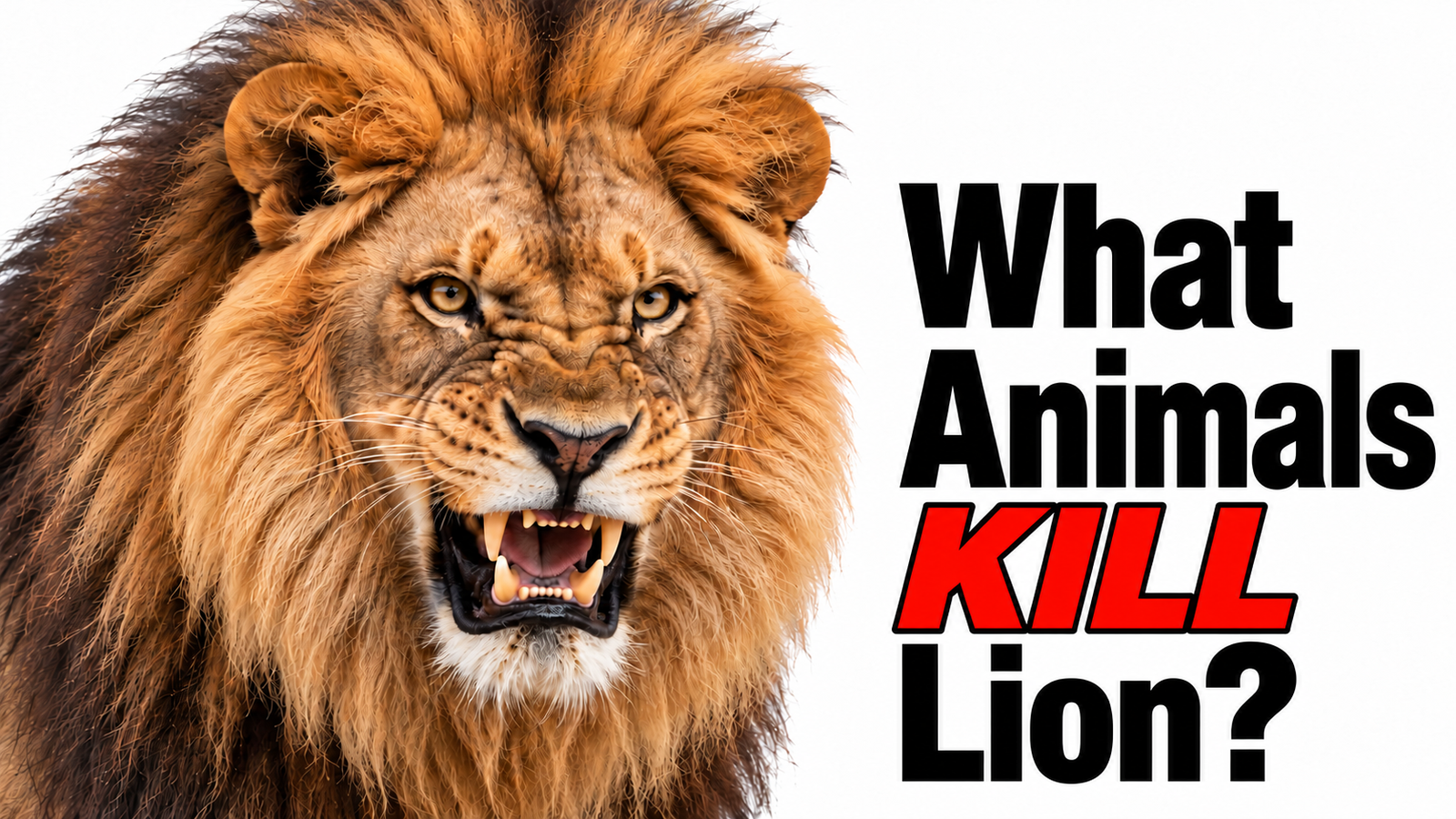
A male lion weighs 330 to 550 pounds and usually lives in a group. That makes it one of the most feared predators in Africa. Still, it isn’t unbeatable, and some animals can kill it, wound it fatally, or simply chase it away.
We ranked six challengers, starting with the debates people still argue about and ending with matchups that are barely a fight at all. Each one has a specific weapon that targets a real lion weakness, from water and armor to quills and sheer mass.
You’ll also find out which lion rivalry is pure speculation, which tiny animal can kill a lion weeks after losing to it, and why adult lions simply step aside for one giant.
Tiger vs. lion: who would win?
Tiger versus lion is the most famous and most controversial "who would win" debate. It’s also the only hypothetical matchup on this list. The two cats shared India until the early 1800s, but today they never meet in the wild.
On the scale, it’s nearly a tie. A male lion weighs 330 to 550 pounds, and a wild male Bengal tiger can reach about 575. Both carry the same weapons: big claws and huge canines. The real difference is behavior, because the tiger is a solitary ambush hunter used to killing big prey alone.
Craig Saffoe of the Smithsonian’s National Zoo would bet on the tiger. In his view, the tiger goes for the throat and goes for the kill, while a lion tends to bat you around. In 2010, at a zoo in Ankara, Turkey, a tiger reached through a gap between enclosures and sliced open a lion’s jugular with a single blow. That was one strike, though, not a fight.
The only account of a fight in the wild, from India in 1855, went the other way: the tiger was faster, but the lion got hold of its throat and ended it. Wild lions are also rarely alone, and researcher Craig Packer reportedly holds that a coalition of two or three males would have a clear advantage. Verdict: the tiger wins in theory, but only one-on-one, and it’s speculation.
| Male lion weight | 330–550 lb |
| Wild male Bengal tiger | Up to about 575 lb |
| Shared range | India, until the early 1800s |
| Only wild fight on record | India, 1855 (lion won) |
| Captive case | Ankara, Turkey, 2010 (tiger killed a lion with one blow) |
| Verdict | Hypothetical win, one-on-one only |
African buffalo: the lion’s favorite prey and deadliest enemy
In September 2004, in South Africa’s Kruger National Park, lions attacked a buffalo calf while crocodiles joined in from the water. Then the herd came back, faced down the lions, and rescued the calf. The clip, filmed by David Budzinski and Jason Schlosberg, became known as Battle at Kruger and passed 90 million views.
A buffalo weighs 940 to 1,900 pounds, two to four and a half times as much as a lion. Its horn bases fuse into a bony helmet called the boss. To bring one down, a lion has to cling to its back or muzzle for a long time, with its belly and ribs exposed to the horns.
In Kruger, buffalo are the main prey of male lions. These males are the real buffalo specialists and hunt them alone, by ambush, in dense vegetation, because in the open the herd has time to organize. Lone buffalo and bachelor bulls are regular prey, but a lone lion facing a united herd loses.
Even when the lion wins, it’s putting its life on the line. In Botswana’s Okavango Delta, filmmakers Dereck and Beverly Joubert documented lions being frequently chased, and occasionally killed, by buffalo. Verdict: one buffalo can kill or fatally wound a lion, and a united herd drives lions off almost always.
| Weight | 940–1,900 lb |
| Size vs. lion | 2 to 4.5 times heavier |
| Key weapon | Fused horn bases (the boss) and herd defense |
| Famous case | Battle at Kruger, September 2004 |
| Where they clash | Kruger, Okavango Delta, Serengeti, Maasai Mara |
| Verdict | Can kill a lion; the herd almost always drives lions off |
Can a porcupine kill a lion?
The skull of a man-eating lion from Darajani, Kenya, dated to 1965, has a porcupine quill about 9 inches long driven straight through its muzzle. It’s a striking reminder that a small animal can win in the end. The porcupine weighs about 22 to 53 pounds, roughly a tenth of a male lion.
When attacked, the porcupine runs backward into the predator, aiming for the face. Its quills don’t shoot out, as the myth goes; they detach on contact. Because a lion attacks with paws and mouth, that’s where the quills lodge: muzzle, paws, gums, and even inside the teeth.
The real win comes later. The quills cause infections, eating becomes painful, and weeks later the lion may die or be unable to hunt its usual prey. That can push some lions toward attacking people, and man-eaters like the Darajani lion have been found with exactly these injuries. Researchers have compiled about 50 cases of lions injured or killed by porcupines.
Most of the time, though, the lion eats the porcupine. In the Kalahari Desert, porcupines make up 32.3 percent of lion kills, and the lions that get hurt tend to be young males hunting alone. Verdict: the porcupine loses the fight and sometimes wins afterward, wounding a lion fatally in the long run.
| Weight | About 22–53 lb |
| Size vs. lion | Roughly one-tenth of a male lion |
| Defense | Quills that detach on contact (they are not shot) |
| Documented cases | About 50 lions injured or killed |
| Share of Kalahari lion kills | 32.3% |
| Verdict | Can wound a lion fatally, weeks later |
Nile crocodile vs. lion: why water changes everything
On dry land, a lion has the upper hand against a Nile crocodile. In a river, the result flips. The only thing that changes is what’s under the lion’s feet.
Male Nile crocodiles are Africa’s largest predator and reach up to 16 feet and 1,650 pounds. A 2012 study of all 23 species of crocodiles, alligators, and their relatives found that the biggest bit with three to four times a lion’s estimated bite force. Lions sit at roughly 1,000 pounds of force, while the top crocodilian measurement was about 3,700.
The crocodile ambushes from underwater, locks its jaws, and drags its prey to the bottom to drown it. A lion is a reluctant swimmer, and in water it has nothing to stand on, so its paw strikes and its leap stop working. The crocodile always starts the attack, when a lion crosses a river or drinks at the bank.
Cubs and young lions are most at risk, and many still escape. On Kruger’s Sabie River, a young male got away from two large crocodiles. Adult lion deaths are rare. Verdict: in the water, the crocodile can kill and has the edge almost always; on land, rarely.
| Length | Up to 16 ft (males) |
| Weight | Up to 1,650 lb (males) |
| Bite force | Largest crocodilians: 3–4 times a lion’s estimate |
| Hunting style | Underwater ambush, drag and drown |
| Where they clash | River crossings and riverbanks |
| Verdict | Almost always wins in water, rarely on land |
Rhino vs. lion: armor, horn, and a 5,000-pound charge
A male white rhino weighs around 5,000 pounds, ten to twelve times as much as a lion. Lions and rhinos meet often, but fights are rare. Every known case of a rhino killing a lion involves the black rhino, which is smaller, more nervous, and quicker to charge.
A rhino’s thick, folded skin works like armor, and it charges horn first at up to about 30 miles per hour. A lion kills by grabbing the back and biting the throat or muzzle, but that fails against this much weight and armor. Lions don’t take down healthy adult rhinos, not even as a pride, and even a glancing blow from a mother rhino can break a lion’s hip or leg.
Usually, the rhino charges and the lions scatter. In Kenya’s Maasai Mara in 1998, a female black rhino drove lions off a zebra they had brought down, then gored the zebra herself. Three weeks later, near Kichwa Tembo, she impaled a golden-maned male lion in the middle of mating, and he died two days later.
That is the one dated case of a rhino killing an adult male lion. Lions only win as a pride, against a calf, after separating it from its mother. Verdict: the rhino can kill a lion, but its usual win is driving lions off, and against a healthy adult the lion loses practically always.
| Male white rhino weight | Around 5,000 lb |
| Size vs. lion | 10 to 12 times heavier |
| Charge speed | Up to about 30 mph |
| Defense | Thick, folded skin that works like armor |
| Dated case | Black rhino killed a male lion, Maasai Mara, 1998 |
| Verdict | Lion loses practically always against a healthy adult |
Elephant vs. lion: the matchup lions won’t even try
A bull elephant weighs around 13,000 pounds, roughly 30 times as much as a lion. Lions and elephants cross paths all the time, but fights are rare. Against an adult, a lion doesn’t even try.
The elephant’s weapons are its trampling mass, tusks, trunk, and a herd led by the matriarch, the female in charge. A lion’s method depends on knocking prey down or pinning it, and there’s no way to do either to an animal this size. Elephants push lions off resting spots and away from watering holes, and the lions simply get out of the way.
Young elephants are a different story. In 2014, in Zambia, a 7- to 8-year-old elephant named Hercules, cut off from his herd, escaped 14 lionesses unharmed by getting into the water, and elephant researcher Joyce Poole still called it luck. At Savuti, in Botswana’s Chobe National Park, a pride of 30 lions killed an elephant every three days at the end of the dry season, mostly victims aged 4 to 11.
That is a local, seasonal exception. Verdict: the elephant drives off adult lions practically always, though there’s no documented case of one killing an adult lion.
| Bull weight | Around 13,000 lb |
| Size vs. lion | Roughly 30 times heavier |
| Weapons | Mass, tusks, trunk, and a matriarch-led herd |
| Famous escape | Hercules vs. 14 lionesses, Zambia, 2014 |
| Exception | Savuti pride of 30 lions killed young elephants |
| Verdict | Drives off adult lions practically always |
Frequently Asked Questions
What animal can beat a lion most easily?
The elephant. A bull weighs around 13,000 pounds, roughly 30 times a lion, and adult lions simply get out of its way. There is no documented case of an elephant killing an adult lion, but it drives lions off practically always.
Would a tiger beat a lion in a fight?
It’s a near tie and purely hypothetical, since the two cats no longer meet in the wild. Experts like Craig Saffoe of the Smithsonian’s National Zoo favor the tiger one-on-one, but the only recorded wild fight, from India in 1855, ended with the lion winning. Wild male lions also tend to team up in coalitions.
Can a porcupine really kill a lion?
Yes, though usually not during the fight. Quills lodged in a lion’s muzzle, paws, or mouth can cause infections that leave it unable to eat or hunt weeks later. Researchers have compiled about 50 cases of lions injured or killed by porcupines.
Do buffalo kill lions?
Yes. A single buffalo can kill or fatally wound a lion, and filmmakers Dereck and Beverly Joubert documented lions being occasionally killed by buffalo in Botswana’s Okavango Delta. A united herd drives lions off almost always.
Can a crocodile kill a lion?
In the water, yes. A Nile crocodile ambushes from below, locks its jaws, and drags prey under to drown it, while a lion has nothing to stand on. Adult lion deaths are still rare, and many lions escape.
Has a rhino ever killed a lion?
Yes. In 1998, in Kenya’s Maasai Mara, a female black rhino impaled an adult male lion, and he died two days later. It’s the one dated case of a rhino killing an adult male lion.
The lion has two big advantages, and one of them is its group. Take away the pride, put it in a river, or set it against armor, horns, or 13,000 pounds of elephant, and the king of beasts starts to look a lot less untouchable. Some of these challengers kill outright, some wound with delayed but deadly results, and some only have to show up.
Watch the full video above to see all six matchups ranked, and stay until the end to find out which animal beats a lion most easily. If you enjoy real wildlife showdowns backed by evidence, subscribe to Wild Kingdom Uncovered so you don’t miss the next one.
Sources
- Battle at Kruger (Wikipedia)
- Nile crocodile (Wikipedia)
- Cape porcupine (Wikipedia)
- Bite force quotient (Wikipedia)
- Erickson et al. (2012), Insights into the Ecology and Evolutionary Success of Crocodilians Revealed through Bite-Force and Tooth-Pressure Experimentation, PLOS ONE
Watch more on Wild Kingdom Uncovered on YouTube.